
Architecture and Topology
Network structure, critical service dependencies, connection relationships and architecture simplification needs are reviewed.
- Topology visibility
- Critical service dependencies
- Architecture improvement areas
CYBERSECURITY & NETWORK ARCHITECTURE
InnoInTech receives preliminary assessment and consulting requests in network architecture, secure access, segmentation, vulnerability management, security visibility and operational resilience.
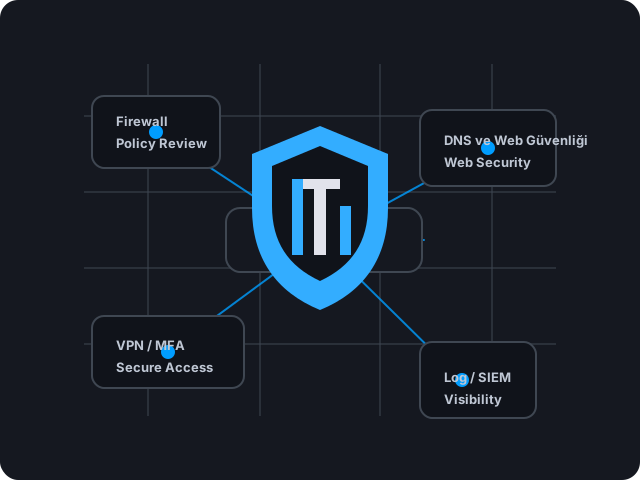
Security needs are reviewed through business goals, risks and the existing environment before product names or tools are considered.
Network structure, critical service dependencies, connection relationships and architecture simplification needs are reviewed.
Access boundaries for critical systems, user and service flows, and remote access processes are reviewed from a security perspective.
Public-facing services are reviewed through domain structure, certificates, routing behavior, web security and external access controls.
Vulnerability findings, security records, alert quality, monitoring processes and resilience controls are reviewed together.
A focused consulting approach helps align recommendations with the real needs, constraints and current architecture of the environment.
The output focuses on feasible improvement steps that can fit the current structure and available resources.
Technical findings are documented with enough detail for specialists and enough clarity for decision makers.
The scope, expected outputs and information handling approach are clarified before any assessment activity begins.
The current status of network, access and security controls is reviewed.
Findings are ordered by impact, risk and feasibility.
Technical detail and a decision-oriented summary are prepared together.
The aim is not only to list findings, but to create an output set that makes the current state understandable and turns it into practical next steps.
Network and security structures are reviewed with an architecture, operational and risk-focused view, producing an improvement roadmap that can be discussed and prioritized.
Existing network structure, service relationships, critical dependencies and security components are reviewed as a connected architecture.
Access boundaries, user and service flows, remote access paths and critical system exposure are reviewed for security and manageability.
Remote access methods, authentication practices, multi-factor verification and third-party access paths are assessed from a security perspective.
Access policies, external connections, management access and logging behavior are reviewed with a risk-focused perspective.
User, device and guest access to the network is reviewed through identity, security and operational control perspectives.
Security log coverage, visibility level, alert quality and monitoring processes are reviewed to identify improvement areas.
Public-facing services are reviewed through domain structure, certificate posture, routing behavior, web security, traffic control and attack surface exposure.
Technical risks affecting selected systems and public-facing services are reviewed and prioritized by impact and feasibility.
Critical connections, security controls, service continuity, resilience approach and recovery readiness are reviewed through an operational risk perspective.
Clear scope boundaries help set the right expectations before any preliminary discussion.
It is not positioned as ongoing operation, alert handling or permanent monitoring.
Vulnerability and risk prioritization is a different type of work from penetration testing, which requires a separate scope and authorization.
The assessment is handled in a vendor-neutral way based on the current environment and needs.
It does not guarantee the outcome of a specific audit, standard or certification process.
It makes the current state more visible, prioritizes risks and provides practical improvement recommendations.
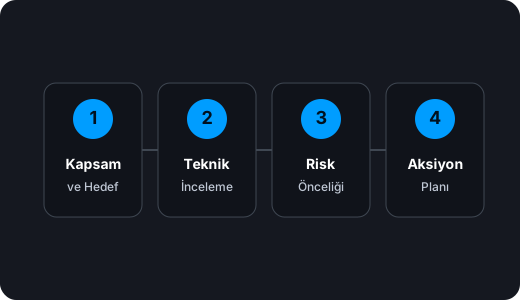
The current environment, critical systems, assessment areas and boundaries are clarified together.
Topology, access flows, security policies, log sources, resilience approach and existing controls are reviewed.
Findings are classified by impact, risk, feasibility and operational priority.
Technical findings, decision summary and practical improvement steps are presented as an action plan.
Review short guides on network security, segmentation, vulnerability management and resilience.
It makes system relationships, critical dependencies, access flows and improvement areas more visible, so technical risks can be prioritized with clearer context.
Segmentation helps limit access to critical systems and reduce unnecessary connections. The assessment reviews existing access flows and provides recommendations for a more manageable structure.
No. Vulnerability management focuses on identifying, classifying and prioritizing known security weaknesses. Penetration testing requires a separate scope, authorization and methodology.
A technical group receives a current-state summary, prioritized findings, practical recommendations, validation notes and a short-to-medium term improvement roadmap.
Readiness is reviewed through critical service dependencies, resilience approach, monitoring visibility and basic recovery scenarios. The goal is to make current readiness and improvement areas visible.
CONTACT
You can briefly describe your current environment, the challenge you are facing or the area you would like to assess. Your request will be reviewed to determine a suitable scope.
Use the preliminary form to share the current context, priorities and assessment scope you would like to discuss.